The Leadership Clarity Tax: Why Executives Become the Company’s Human Search Engine
When the most informed person in the room is also the only one who can assemble the story, clarity becomes expensive, and progress slows down.
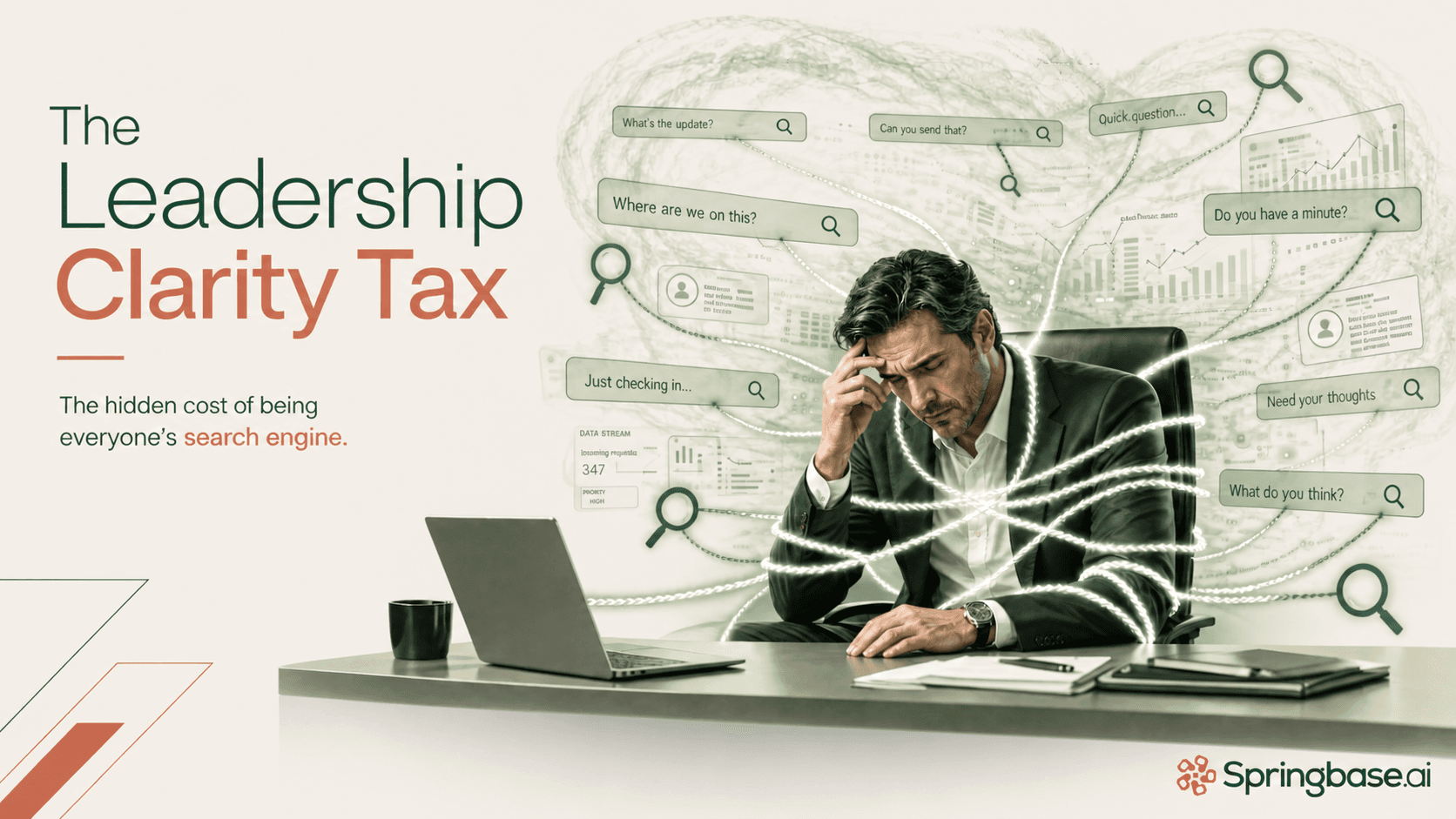
It is 8:12 on Monday morning. A leader has a staff meeting in less than an hour, a customer escalation later that day, and a board update due on Thursday.
Before any of that can happen, they have to reconstruct the business.
They scan meeting notes for a commitment made last week. They search messages for the latest status of a launch blocker. They ask a direct report whether the forecast changed after Friday’s customer call. They open a slide deck that may or may not contain the current plan. They remember a concern raised in a conversation that never made it into a document.
Then they do what capable leaders have always done: piece the fragments together, identify what matters, decide what to ask next, and turn ambiguity into direction.
It looks like leadership. Too often, it is expensive retrieval work.
This is the leadership clarity tax: the hidden cost of making leaders serve as the company’s human search engine. It is paid in late nights, repeated status meetings, slow decisions, fragile institutional knowledge, and a persistent sense that important work is moving—without anyone being fully sure where it stands.
The problem is not that leaders need context. They do. Judgment without context is guesswork. The problem is that the context required to lead is scattered across conversations, documents, dashboards, and people’s memories and then reassembled manually by the few people expected to make good decisions quickly.
AI can either worsen this pattern or help break it. Another tool that generates a polished paragraph from a vague prompt will not solve the problem. Business leaders do not need more summaries to review. They need a shared operating layer that turns company knowledge into a visible Plan, a usable leadership brief, and accountable next steps.
Clarity is not a leadership perk. It is operating infrastructure.#
Every organization has a version of the same weekly ritual.
A team arrives at a meeting with updates. Marketing has a view of the campaign. Sales has a view of the account. Product has visibility into the roadmap. Operations has visibility into delivery risk. Each perspective is valid. None is complete.
The leader’s job becomes synthesis: What is actually happening? What changed? What is at risk? Who owns the next move? What decision cannot wait?
That work is essential. But when the basic assembly of context depends on one leader’s memory and stamina, the organization has created a bottleneck disguised as competence.
The symptoms are familiar:
- Status meetings repeat information that already exists somewhere else.
- Teams disagree about priorities because they are working from different versions of the truth.
- Important commitments disappear between a meeting and the next follow-up.
- Decisions are delayed while someone “gets the full picture.”
- Senior people spend disproportionate time translating context across functions.
- Work slows down whenever a key operator is unavailable.
None of these failures are usually caused by a lack of effort. They are caused by a lack of connective tissue between information and action.
A dashboard can show performance. A meeting transcript can record a conversation. A document can describe a strategy. But leaders need something more demanding: a current, coherent view of the business that is designed to support a decision.
The leadership clarity tax is not the cost of being informed. It is the cost of repeatedly rebuilding shared understanding from scattered information that should already be connected to the work.
The false promise of the AI summary#
Many organizations have already applied AI to the symptoms of this problem. They summarize meetings. They condense documents. They answer questions across a set of files. These capabilities can be useful, especially when teams are drowning in information.
But summaries are not a management system.
Consider a regional sales leader preparing for a quarterly review. The raw material is everywhere: account-team notes, pipeline updates, customer calls, product feedback, renewal risks, and leadership conversations. An AI summary may tell them that several strategic accounts need attention.
That is not enough.
The leader needs to know which accounts are at risk, what evidence supports that assessment, which commitments have been made, where the internal dependencies sit, who owns the recovery plan, and what decision is needed from leadership. They need a leadership brief that can be reviewed, challenged, and used.
The distinction matters. A summary reduces text. A useful work product creates alignment around what happens next.
This is where AI meeting intelligence should evolve. A meeting is not valuable because it produced a transcript or a list of talking points. It is valuable when the decisions, commitments, risks, and follow-through from that conversation become visible in the operating rhythm of the business.
After an executive staff meeting, for example, teams should not have to wonder:
- Which decisions were final?
- Which questions remain open?
- What changed in the plan?
- Who owns each next step?
- When will leadership revisit unresolved risks?
Those are not note-taking questions. They are execution questions.
From scattered updates to a shared operating view#
The answer is not to force every piece of company information into one giant repository and hope people search more effectively. Leaders do not need a larger pile of context. They need the right context applied to the right business question.
That is the role of an AI knowledge base built for work: not merely storing information, but making relevant company knowledge available when a team needs to make a decision, prepare a brief, resolve a risk, or execute a plan.
At Springbase.ai, we think of this as moving from answers to an operating loop:
Goal → Plan → Data → Execute → Asset → Recipe#
A practical model for turning company context into accountable work.
- Goal
Define the business outcome that matters.
2. Plan
Make the workflow visible, editable, and reviewable.
3. Data
Bring in the company context needed to do the work well.
4. Execute
Use AI and people to move the work forward.
5. Asset
Create finished, usable output for a real audience.
6. Recipe
Save the successful workflow for the next time.
The model begins with a question leaders can recognize immediately: what must we accomplish?
Not, “Can AI summarize the weekly updates?” But, “What does the leadership team need to decide this week, and what information will make that decision clear?”
That shift changes the work. It makes the desired outcome explicit. It replaces a generic request for content with a defined leadership Asset: perhaps a weekly operating brief, a launch readiness report, a customer escalation plan, or an executive decision memo.
Goal: Define the decision, not just the deliverable#
Leaders are often handed deliverables with no decision attached. “Prepare an update.” “Put together a readout.” “Summarize the meeting.”
Those requests create room for activity without clarity.
A stronger Goal is specific about the business moment. For example: “Prepare the leadership team to decide whether to adjust the launch timeline, based on current customer feedback, delivery dependencies, and revenue impact.”
Now the team knows what matters. The output must be decision-ready, not merely complete.
Plan: Make the path to clarity visible#
The most valuable work rarely follows a single prompt. It follows a sequence: gather inputs, identify what changed, test assumptions, surface trade-offs, draft the recommendation, and review it with the right people.
That sequence should not disappear into an opaque process. It should be a visible, editable Plan.
For a leadership weekly brief, a Plan might include:
- Collect updates from the current operating cycle.
- Review relevant meeting decisions and unresolved commitments.
- Identify changes to priorities, milestones, risks, and dependencies.
- Distinguish facts from assumptions and open questions.
- Draft recommended decisions and clear ownership for next steps.
- Produce a concise brief for leadership review.
The Plan is not a process for process’s sake. It gives leaders and teams the chance to inspect the logic of the work before it becomes a polished document that obscures weak inputs or missed issues.
Data: Use live contexts, not stale fragments#
Leadership work is unusually sensitive to timing. A strategy document from three months ago may still matter, but it cannot outrank a new customer commitment, a changed delivery date, or a decision made yesterday.
That is why static retrieval is not enough. Teams need live contexts: relevant, current company information connected to the work at hand.
For a customer escalation, live contexts may include recent meeting notes, account history, implementation status, open product issues, and the commitments already made to the customer. For a leadership planning session, they may include operating metrics, functional updates, prior decisions, and the latest view of strategic risks.
The goal is not to pretend that every source is equally trustworthy. The goal is to make the inputs visible, relevant, and available for challenge. Good leadership depends on being able to ask: What is this recommendation based on? What has changed? What are we missing?
AI agents should reduce coordination work, not accountability#
There is a useful role for AI agents in this operating model, but it is not the theatrical version of autonomy where software is asked to “run the business.”
The meaningful opportunity is more grounded. AI agents can help teams perform defined, repeatable parts of the work that currently consume attention without requiring executive judgment.
They can help gather and organize inputs, compare recent updates against a prior plan, identify stated commitments in meetings, prepare structured drafts, surface inconsistencies, and assemble a first-pass leadership brief.
That matters because leadership teams are routinely slowed by coordination labor: chasing updates, reconciling versions, formatting materials, and repeatedly asking for context that already exists somewhere in the organization.
Take a cross-functional launch. A capable leader should spend the review discussing the trade-off between speed, quality, customer impact, and resource allocation. They should not spend the first half of the meeting discovering that three teams were working from different launch dates.
AI workflow automation can reduce that friction when it is attached to a clear Plan. It can help transform dispersed updates into a structured view of:
- What is on track and what has changed.
- Which dependencies need attention.
- What decisions are required and by whom.
- Which commitments need follow-through.
- What should be communicated to the broader organization.
Human judgment remains central. Leaders decide what to prioritize, which risks to accept, and how to respond when evidence conflicts. The point of AI is not to replace that responsibility. It is to ensure responsibility is not buried beneath avoidable assembly work.
The leadership brief should be an Asset, not a disposable update#
Most leadership updates are treated as temporary artifacts. They are assembled for a meeting, discussed for an hour, and then disappear into a folder or chat thread.
That is a missed opportunity.
A strong leadership brief is an Asset: a finished, usable work product that gives a team a shared view of what matters and creates a basis for action. It should be designed for use, not simply for consumption.
A useful leadership Asset might include:
- The few business outcomes currently requiring leadership attention.
- What changed since the last operating review.
- Evidence, context, and uncertainty behind key conclusions.
- Priority risks and the owners accountable for addressing them.
- Decisions needed, with the trade-offs made explicit.
- A clear record of next steps and when they will be revisited.
Notice what is absent: pages of undifferentiated status. More information does not create more clarity. A leadership Asset earns its place by helping the organization decide, align, and move.
It also improves the quality of future work. When a brief falls short, the team can identify why. Was the Goal vague? Did the Plan miss a critical review point? Was the Data incomplete? Did the team fail to connect a meeting commitment to the execution plan?
That is a far better learning loop than concluding that AI, or the team, produced “a bad update.”
Turn a reliable rhythm into a Recipe#
Every organization has a few people who know how to create clarity under pressure. They know which questions expose a hidden risk. They know how to separate a real blocker from a passing complaint. They know how to frame a decision so it can actually be made.
That expertise should not live only in personal habits.
When a team develops a leadership rhythm that works, it should become a Recipe: a saved, repeatable workflow that captures the sequence, context, review points, and expected Asset for the next cycle.
A weekly operating review Recipe might define the inputs to gather, the questions that every functional update must answer, the format of the leadership brief, the escalation criteria, and the follow-up process after decisions are made.
It does not make leadership mechanical. It protects leadership time for the parts that demand discernment.
That is the promise of enterprise AI workflows done well. They do not standardize away judgment. They make the recurring path to good judgment easier to execute, easier to improve, and less dependent on one person carrying the company’s context in their head.
Stop making leaders rebuild the business every Monday#
The leadership clarity tax is easy to normalize because high-performing leaders are remarkably good at paying it. They remember the missed commitment, find the buried document, ask the follow-up question, and connect the dots no one else has connected.
But a business should not have to rely on individual heroics to understand its own priorities.
The better model is shared clarity: company context brought into a visible Plan, transformed into a useful Asset, and improved over time as a repeatable Recipe. That is how leaders spend less time searching for the story and more time deciding what the organization will do next.
Start with one recurring leadership moment this week. Choose the meeting, review, or decision cycle that currently requires the most manual context-gathering. Define the Asset leaders actually need. Make the Plan visible. Connect the right live contexts. Then save the rhythm that works.
AI should not give leaders another paragraph to read. It should give the organization a clearer way to move.
Related Posts
Kimi K3 and the New Question for AI: What Can Your Business Actually Do With It?
A balanced, business-first look at Moonshot AI’s Kimi K3 launch, why its long-context and agentic capabilities matter, where the benchmark story needs caution, and how operating layers like Springbase turn frontier model power into usable work.

When the Machine Learns to Listen
AI is changing music not only by generating songs, but by widening the circle of who gets to make them, whose voices can be remembered, and how artists may shape sound in the years ahead.

GPT-5.6: The Enterprise Control Plane
OpenAI’s new Sol, Terra, and Luna family points toward a more practical operating model for enterprise AI: faster agents, smarter routing, reusable context, and a clearer path from experimentation to real business productivity.